
| Coming together under God
By Pat Healy More than 200 area residents gathered last Sunday night at Temple Beth Elohim for an interfaith dialogue between Christians and Jews. The program, called “Meeting at the Edges” was the first of its kind for Wellesley, bringing together members of Beth Elohim and the Wellesley Congregational (Village) Church. “We’re all more alike than we are different,” said Beth Elohim’s Rabbi Joel Sisenwine, welcoming participants to the program. Reverend Martin Copenhaver of the Village Church agreed. “We worship the same God, it’s just that you’ve been worshipping that God a whole lot longer,” he said to the Jewish people in the audience. In a town where many of the Jewish participants spoke of having seen more than a few incidents of anti-Semitism, the meeting was an important effort at working towards an understanding between the two communities. “The more we know about each other, the less likely it is that untruths about the other group will take on lives of their own,” said Newton resident Allan Miller. Guest speakers at the event included Rabbi David Gordis, president of Hebrew College and Reverend Dr. Benjamin Griffin, president of Andover Newton Theological School. Both speakers indicated that the goal of the gathering was to learn from the “otherness of the other,” which is not always easy. Rabbi Gordis said problems arise when people perceive the differences of the other as a challenge. “Those differences are viewed as threatening and that they have to be dealt with and corrected by some process of homogenization or purification,” he said. Rabbi Gordis noted that the tendency to want to convert each other is as old as religion itself, and that it can be a negative force during interfaith dialogue. Reverend Griffin said that when one is part of the majority is difficult to understand the minority. But the minority can usually understand the majority pretty easily. He broadened the discussion to whites and African Americans. “African Americans don’t have a problem understanding who we are but we often have a problem understanding who they are, and we often (incorrectly) assume that if they would just be like us, everything would be so much better,” he said. He said that although Jesus and the first Christians were Jewish, within Christianity “there remains a kind of anti-Semitism which in its most obvious form we can understand, but as with racial prejudice it is the polite and liberal kind that is often the most insidious.” Reverend Griffin said the sort of Christian anti-Semitism he was talking about even manifests itself in parking problems between Hebrew College and Andover Newton Theological School, which are located near one another in Newton. In break-out groups members from each congregation demonstrated a willingness to learn about the other group and brainstormed ways to improve relationships between the two communities. Ann Spencer of Natick suggested that interfaith social activism such as a soup kitchen would help start the dialogue on a personal level. “By working together more on activities that are not directly linked to religion we could learn more about each other,” she said. Michael Yogg, a Wellesley resident moderating one of the break-out groups agreed that it is difficult to immediately begin religious dialogue between the two groups, and suggested that was the reason the program was called “Meeting at the Edges.” “It’s hard to have the frame of mind that everyone has their own roads to salvation,” he said. Wayland resident Richard Saloman said he has seen the face of anti-Semitism in certain Massachusetts communities, but dialogue such as this can only be helpful to reach understanding between groups. “We all want pretty much the same thing,” he said, “which is peace in this world.” |
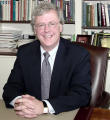 "We worship the same God, it's just that you have been worshipping that God a whole lot longer," said Rev. Martin Copenhaver 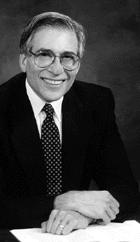 Rabbi David Gordis said problems arise when people perceive one another's differences as challenges. |