
| Bowler seeks new ideas to drive auto competition
By Pat Healy At least it is according to Mass. Insurance Commissioner Julianne M. Bowler, who said as much at a meeting earlier this month. Speaking at a breakfast meeting in Springfield, Mass., at the Association of Insurance Compliance Professionals’ Education Day, Bowler said how over the past four years, the state has lost six companies and had no new entrants in the market. "I’m amazed that the 20 companies that are still here actually want to pour capital into this market," she said. "I believe that in a few more years we’ll be lucky if we have numbers in the double digits." Bowler spoke about the fact that five companies control 67 percent of the market in Mass., where other personal lines have more equally distributed competition, and she also offered hope for change. "In order to get to a healthy market we’re going to have to slowly unwind these subsidies because you can’t do it overnight," she said. Since taking office Bowler has been quietly seeking ideas about how to increase competition within the current system, as Massachusetts continues to be one of the most heavily regulated auto insurance states in the nation. When she received only minimal response after inviting industry members to submit ideas on competition during the competition portion of last year’s rate case hearing, she put together a working group to generate ideas. Including politicians, regulators, agents and company representatives, the group faced a daunting task: how to add an ingredient to a system that was nearly destroyed by the same ingredient the last time someone had a go of it. In the late 1970s competition was introduced in the Massachusetts auto insurance market all at once and the market went into rate shock, killing the idea of competition. Since then an annual hearing is held to gauge whether or not competition in the market should be introduced. The hearing, said Frank O’Brien of the Alliance of American Insurers, is usually a formality in a system that nobody plans on changing. But this year’s hearing, on Friday, May 16th, could be different. "It is our hope, expectation, and indeed our understanding that based on her public pronouncements in a number of forums that the commissioner intends to treat this regulatory process as a real hearing and not the mere formality it has been in the past," said O’Brien. "One of the things that needs to be learned is that whatever changes in the system, it must be undertaken in a well-thought out step-by-step process and not put into place hurriedly and without a lot of forethought." O’Brien said he plans on testifying at the hearing, and Bowler hopes many more join him next Friday. "I’d like to see the companies and the agents take an active role in the competition hearing," she said. "I’d like to see them come forward and put stuff on the record that they have said to us off the record because I think we need to deal with this in an open and honest way, and if we want to get a more competitive market we’re going to need their assistance to get there and we’re going to need the information that they’ve got to be placed in the public domain." Bowler said this discussion includes recommendations about Commonwealth Automobile Reinsurers, pricing and ERPs. Automobile Insurers Bureau head Daniel J. Johnston was a participant in the working group formed by Bowler, but he will not testify. "That hearing is for people who have an opinion, and we remain neutral on that," he said "but we do support the outcome of the decision." Frank Mancini, executive vice president of the Massachusetts Association of Insurance Agents, and another member of the working group, said the group’s last meeting was a few months ago, and one of the only conclusions they came to was that if Massachusetts was to move to competition it would need to be done in baby steps. "They’ve been working on this for the last 25 years," he said. "They just never get to the finish line. It’s a very contentious issue, and when we left off we had agreed on a few ways we could begin to offer some competition through optional endorsements, but this is just the beginning of the beginning." O’Brien agreed. "It took us a long time to get where we are, and it will take us some time to unwind where we are if this is to be the case," he said. "The industry and regulators and legislators and the public all need to be cognizant of the lessons of the 1970s." Aside from the lack of competition within the industry, Bowler said there are other problems with the status quo. "What makes Massachusetts so unique is the degree to which we subsidize inexperienced drivers, particularly males," she said. She said the Division of Insurance has done a study looking at Connecticut, Rhode Island, New York, D.C, and Pennsylvania, which are all areas comparable to Mass. in income, weather, urban density and general demographic makeup. The results of the study showed that inexperienced drivers in Mass. have rates that average $1,000 less than what they would be paying in those other states. "And that’s really the problem because you can’t move to a competitive system when you have that degree of subsidization in the market," she said. |
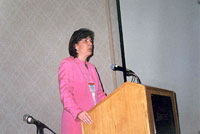 Mass. Commissioner Julianne M. Bowler |